
A small room rarely feels crowded because of one large object. More often, it feels crowded because too many unrelated objects divide the floor, interrupt sightlines, and compete for attention.
That is why minimalist design can work so well in compact homes. It replaces accumulation with decisions: what needs to remain accessible, what deserves to be displayed, and what can disappear from view. Done well, minimalism is not an empty white room. It is a room where the useful things have enough space to be noticed.
Measure the room before choosing the furniture
Start with the space that people need to move through, not with the space left over for furniture. Mark the likely footprint of a new piece with painter’s tape, then walk around it. Open the nearby door, drawer or cabinet. Sit in the chair beside it. A product can fit according to its dimensions and still interfere with the way the room works.
In a narrow living room or studio, protecting one clear route often matters more than gaining a little extra storage. Keep frequently used paths visually simple and avoid placing several small objects along them. A single purposeful piece against the wall usually creates less friction than a sequence of baskets, stools and improvised stands.
Choose fewer pieces, not merely smaller ones
Small furniture is not automatically space-efficient. Three undersized pieces can consume more visual and physical space than one properly proportioned object. They also create more legs, edges, gaps and surfaces for the eye to process.
Before buying, define the job in plain language. Do you need to keep the records you play most often beside the turntable? Hold a working row of books upright? Keep firewood contained without filling the hearth area? Once the job is specific, it becomes easier to reject furniture that adds volume without adding enough function.
This approach is especially useful for collections. Instead of spreading records, books or fireplace tools around a room, give each category one deliberate home. The room becomes calmer because storage reads as part of the composition rather than as evidence of overflow.
Use compact storage where the activity already happens
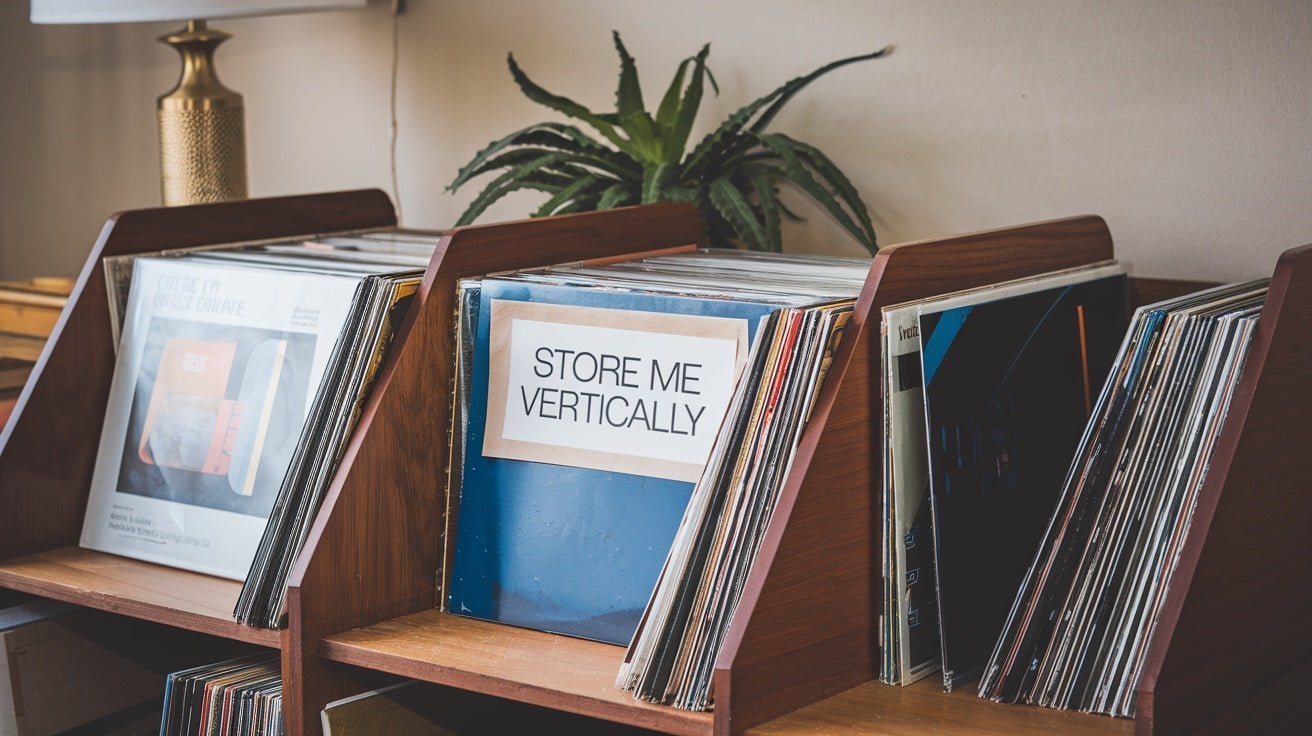
Storage works hardest when it sits close to the activity it supports. A desktop record stand beside a turntable can hold a listening rotation without requiring another cabinet. Bookends can turn part of an existing shelf into stable storage. A compact log holder near the fireplace contains wood where it is actually used.
These are small interventions, but they prevent objects from migrating to tables, floors and windowsills. The result feels more minimal because daily routines require fewer temporary piles.

For a listening corner
Gate desktop vinyl stand
A compact steel stand for up to 50 LPs. It keeps a current listening selection visible and close to the turntable without adding a full storage cabinet.
Keep more of the floor visible
Visible floor area helps a compact room read as one continuous space. That does not mean every piece must float on thin legs, but it does mean avoiding a broken perimeter of unrelated objects. Group storage deliberately and use the vertical plane where it makes sense.
For vinyl collections, a compact stand can serve the records in active use while a larger piece handles the archive. For books, a strong pair of bookends can make an existing shelf work harder. The principle is the same: use the surfaces you already have before adding another footprint.
Open storage should remain edited. If everything is displayed, nothing becomes a focal point. Leave breathing room around the objects you want to see and move packaging, cables and maintenance supplies into closed storage.

For an existing shelf
X-shaped steel bookends
A sculptural way to organise a working row of books without adding another piece of furniture. Available individually or as a pair.
Repeat materials to reduce visual noise
A compact room can contain colour and personality, but repetition helps it feel coherent. Choose a small material vocabulary—perhaps powder-coated steel, natural wood and one textile family—and repeat it across the room. Matching every object is unnecessary; the aim is to create relationships.
Black steel can outline a space without introducing another bulky visual mass. A coloured powder-coated piece can become the room’s deliberate accent when nearby objects remain quieter. If you already have several wood tones, a neutral metal element can connect them without pretending they are identical.
Limit finishes where the room is busiest. Around a turntable, fireplace or desk, two or three recurring materials are usually enough to give the area character while keeping it readable.
Choose objects that still look considered when partly empty
Storage in a small home is visible during different seasons and routines. A record stand may be half full after you return albums to the main collection. A log holder may remain empty for much of the year. Pieces with a clear silhouette continue to contribute to the room even when they are not at capacity.
This is one reason simple metal forms are useful in compact interiors: the structure does not depend on decoration or fullness. It can hold, divide and frame without becoming visually heavy.

For a compact hearth
Compact log holder with copper accents
A contained footprint for indoor firewood, with a graphic frame that remains intentional when the holder is not completely full.
A practical order for furnishing a small room
- Protect circulation. Mark the main route and the clearance needed for doors, drawers and chairs.
- Solve the largest daily problem. Choose the one piece that removes the most recurring clutter.
- Use existing surfaces. Improve shelves, desktops and wall-adjacent space before adding another cabinet.
- Repeat a finish. Connect the new object to something already in the room through colour or material.
- Stop and live with it. Let the room reveal the next real need instead of furnishing every empty corner at once.
You can explore our vinyl record storage, metal bookends and indoor log holders by function. Dimensions are listed on each product page so you can mark the footprint at home before deciding.
Frequently asked questions
How do you make a small space feel less cluttered?
Keep the main walking routes clear, group similar objects in one place, and reduce the number of separate pieces sitting on the floor. Closed storage is useful for visually irregular items, while edited open storage can display the objects you genuinely want to see.
Is minimalist furniture always small?
No. The best piece is correctly scaled for its job and surroundings. One medium-size object that solves a complete storage problem can feel calmer and use less total space than several tiny pieces.
What furniture should you buy first for a small apartment?
Begin with the piece that supports the most frequent activity or removes the most persistent clutter. Measure circulation and door clearance first, then mark the proposed footprint with tape before buying.
How many materials or finishes should a small room use?
There is no fixed rule, but repeating two or three main materials in a busy area usually creates coherence. Additional colours and textures can appear as accents without each becoming a new dominant finish.
Is open storage good for small spaces?
It can be, particularly for objects used often or worth displaying. Keep it edited and leave some empty space around the contents. Packaging, cables and miscellaneous supplies are usually calmer behind a door or inside a drawer.
Continue reading